
Scaling Meeting Rooms Without Licensing Overhead
Discover how OneTap's centralized management avoids unwanted room level licensing overhead and simplifies governance when scaling meeting rooms across locations.
3/3/20262 min read
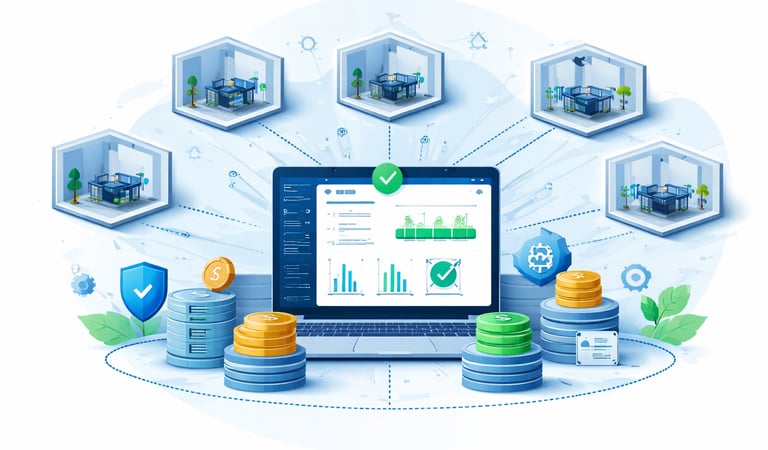
When organisations grow from five meeting rooms to twenty-five, something changes. It isn’t the hardware. It’s the administrative surface.
Each additional room can mean another endpoint to configure, another policy surface to manage, and often another licensed entity inside your collaboration environment.
At small scale, this is invisible. At enterprise scale, it becomes operational weight. The real question is not how to equip a single room. It’s how to scale small meeting room infrastructure without scaling IT complexity.
A Centralized Model for Small Meeting Rooms
OneTap was designed around a simple principle: Small meeting rooms should scale without multiplying administrative effort. All OneTap devices are governed through a single centralized management console. From that console, IT teams can:
Monitor device health
Push updates remotely
Standardize behaviour across rooms
Maintain consistency across floors and locations
When a new room is added, it follows the same configuration model as the others. There is no room-by-room setup drift. No independent configuration silos. No fragmented governance. Control remains centralized and rooms act as endpoints.
That distinction becomes critical when managing dozens of small meeting rooms across an organisation.
Understanding the Licensing Reality
There are two distinct meeting interactions:
Joining a scheduled meeting
Starting a new meeting
If a user wants to start a meeting, they must be licensed within their collaboration platform. That is true in any system — including OneTap.
But joining a scheduled meeting from a room is a different architectural question. Many traditional video conferencing systems treat each physical meeting room as an independently licensed digital identity.
Room = license.
Room = administrative object.
Room = directory presence.
That model works — and it is widely adopted. But it scales linearly with the number of physical rooms. OneTap approaches this differently.
Rooms are endpoints within a centrally managed infrastructure. They do not introduce unnecessary room-level licensing overhead. The identity layer remains centralized rather than multiplied across physical spaces. The outcome:
Users remain licensed individuals
Rooms do not multiply the licensing footprint
Administrative objects do not scale with square footage.
At five rooms, this difference feels small. At fifty rooms, it becomes meaningful.
Why This Matters to CIOs and IT Managers
When evaluating meeting room systems, hardware comparisons are straightforward. The more important question is architectural: How does this system scale across locations? Does each new room introduce:
Another license to manage
Another identity to govern
Another object inside your directory
Or does it simply add another endpoint under existing control?
With a centralized meeting room management model, scaling becomes predictable - Rooms increase while administrative effort does not. Licensing remains controlled and Governance stays clean. For enterprise environments, that translates into:
Lower long-term operational cost
Simpler audits
Reduced identity sprawl
Faster deployment of new offices or floors.
Infrastructure Should Scale Differently
Meeting rooms are physical spaces. They should behave like infrastructure — not like independent digital users inside your environment. When centralized control replaces room-level licensing overhead, small meeting rooms become easier to deploy, easier to manage, and easier to scale. And at enterprise scale, architectural choices determine operational outcomes.
Explore a Scalable Approach
If you’re evaluating how to scale small meeting rooms across locations without multiplying licenses or administrative complexity, a centralized model may be worth considering. Explore how OneTap enables consistent small meeting room governance with predictable cost and centralized control.
Follow Us
Connect
sales@tifoh.com
© 2025. All rights reserved.
+91 7678662078